
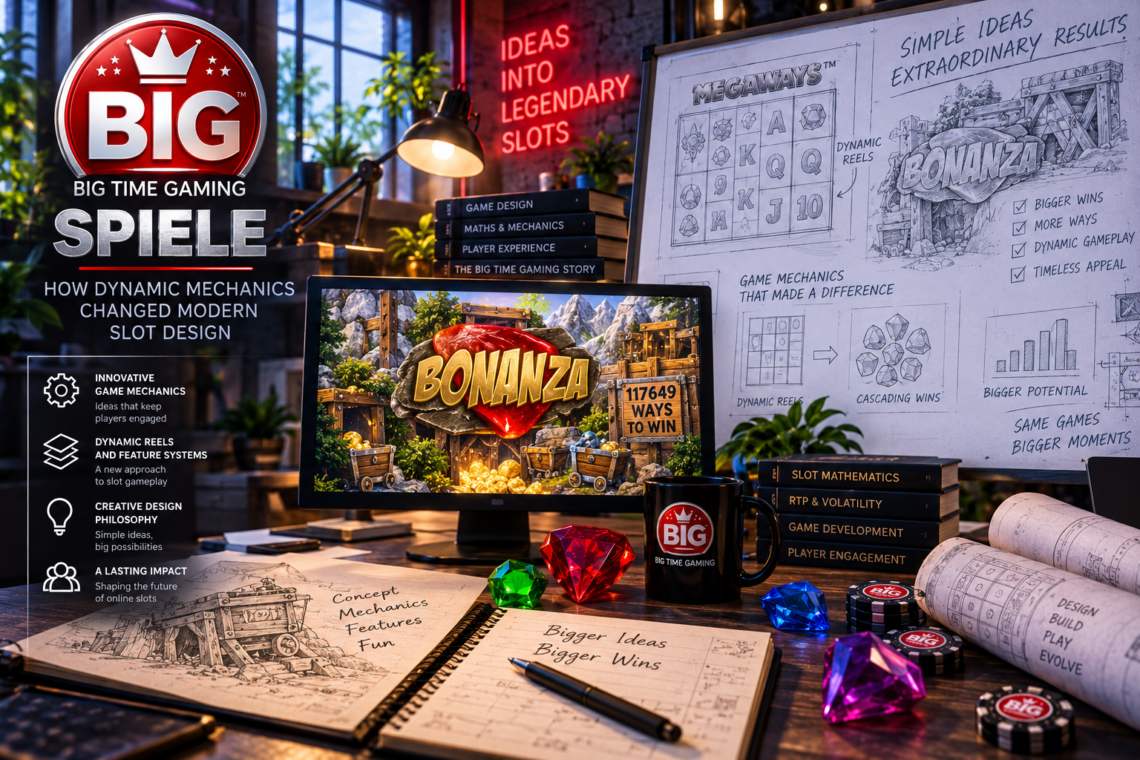
Online slot development has moved far beyond the traditional model of fixed reels and predetermined paylines. One of the studios most closely associated with this transformation is Big Time Gaming, whose distinctive approach to mathematical design has influenced how modern slots are built and presented. The dedicated big time gaming spiele collection on Voodoo brings this provider’s content into a single catalog environment, with 76 Big Time Gaming titles currently listed on the platform.
Big Time Gaming is now part of the Evolution group, but it continues to operate as a distinct brand with its own creative identity. The studio is particularly recognized for Megaways™, a mechanic that replaced the traditional fixed-payline model with changing reel configurations and variable numbers of ways to win. Evolution describes this technology as one of the most influential innovations in modern online slot design.
The Idea That Changed the Reel Structure
For decades, the basic architecture of a slot was relatively predictable. A game had a fixed number of reels, a defined number of rows and a predetermined set of paylines. Developers could alter the graphics, themes and bonus features, but the underlying visual structure often remained familiar.
Megaways™ introduced a different philosophy. According to Evolution’s current description of Big Time Gaming, the system allows reel heights to change from spin to spin, with between two and seven symbols potentially appearing on each reel. This can create as many as 117,649 possible ways to win.
The significance of the concept is not simply the size of the resulting number. The important change is that the game’s configuration can vary dynamically.
A player therefore does not necessarily encounter exactly the same reel structure on every spin. The mathematical framework itself becomes part of the visual experience, creating a sense of movement and variation that differs from conventional fixed-payline slots.
From One Mechanic to an Entire Design Philosophy
Megaways™ became so closely associated with Big Time Gaming that it can sometimes overshadow the studio’s broader contribution to slot development.
The provider has continued to experiment with other proprietary mechanics, including Megaclusters™, Megadozer™, Megapays™ and Megapots™. Evolution’s current Big Time Gaming profile presents these systems as part of a wider philosophy centered on scalable mechanics and dynamic gameplay.
This is important from a design perspective. A successful mechanic can easily become a template that developers reproduce indefinitely. Big Time Gaming instead positioned its recognizable brand around continued experimentation.
The objective is not simply to make reels look different. It is to change the way symbols interact, how potential combinations are generated and how the player perceives each individual game state.
That approach has helped turn the provider into a recognizable name within the technical history of online slots.
Why Dynamic Ways to Win Matter
The traditional concept of paylines is easy to understand: a particular combination of symbols must appear along one of a defined set of lines.
A dynamic system introduces another variable. The number of symbols present on each reel can change, which means the number of possible combinations can also change.
This creates a different mathematical environment for the game. Instead of knowing that every spin will operate with exactly the same visible number of positions, the player encounters a changing configuration.
The important point is that more possible combinations do not mean a guaranteed improvement in outcomes. They simply describe how the game is mathematically structured.
That distinction is essential when discussing sophisticated slot mechanics. A larger number of potential winning combinations should never be interpreted as a promise of higher returns.
Big Time Gaming Within the Voodoo Catalog
The presence of a dedicated provider page allows users to explore Big Time Gaming content without searching through the entire casino library.
Voodoo’s German catalog currently contains more than 8,000 games overall and includes dozens of individual providers. Big Time Gaming is represented by 76 titles in the current provider directory.
This is a useful example of how provider-based navigation can improve a large digital casino.
Instead of treating every slot as an isolated product, a user can identify the developer and explore its broader portfolio. This is particularly valuable for studios with recognizable mechanics because users who enjoy one technical approach may want to investigate other games created by the same developer.
The provider page consequently functions as a form of specialized catalog within the much larger casino environment.
The Evolution Connection
Big Time Gaming’s position within the Evolution group is another important part of its modern identity.
Evolution’s current brand portfolio lists Big Time Gaming alongside other major RNG and live-casino brands. The company continues to present BTG as a distinct studio built around inventive slot mechanics while benefiting from the broader resources of the Evolution organization.
This structure combines independence of creative identity with access to a larger international gaming infrastructure.
For users, the distinction between the parent company and individual brand can be easy to overlook. However, it explains why Big Time Gaming can retain its recognizable style while participating in a much broader ecosystem of casino content.
Evolution’s 2026 roadmap also specifically includes Big Time Gaming among the group’s RNG brands, demonstrating that the studio remains an active part of the company’s ongoing content strategy.
Beyond the Original Megaways Concept
The development of Megaways™ was important because it challenged assumptions about what a slot interface needed to look like. But the longer-term significance of Big Time Gaming comes from what happened afterward.
Once dynamic reel structures became commercially established, developers across the industry began experimenting with other forms of variable game architecture.
Big Time Gaming itself moved into additional systems designed around clusters, jackpots, progressive mechanics and changing game grids. Evolution currently identifies Megaclusters™, Megadozer™, Megapays™, Megapots™ and Megaquads™ among the studio’s broader collection of proprietary concepts.
These mechanics demonstrate that the provider’s central philosophy is not tied to one mathematical formula.
Instead, the underlying idea is that slot games can evolve through changes to their architecture rather than relying exclusively on new graphics or themes.
The Importance of Mathematical Design
Modern slot development combines several disciplines. Artists create visual identities, sound designers build audio environments, software engineers implement the interface and mathematicians determine how the underlying game behaves.
Big Time Gaming’s history demonstrates why mathematical design can become part of a provider’s identity.
Megaways™ is not simply an animation or visual effect. The changing number of symbols affects the mathematical structure of the game and therefore has to be incorporated into the software architecture from the beginning.
This makes the provider’s work particularly interesting from a technical perspective. The visible result may be a changing reel layout, but behind it is a complex system that determines how symbols are generated, how combinations are evaluated and how features interact.
The technology is effectively part of the entertainment design.
A Portfolio Built for Digital Platforms
The modern online slot is designed to operate across multiple devices and casino platforms. It needs to function within desktop browsers, mobile interfaces and different technical environments supplied by operators.
That makes integration an important part of the provider business model.
Big Time Gaming operates as a B2B gaming supplier, while its games are distributed through casino operators and other industry channels. The Voodoo collection is one example of how the studio’s content becomes part of a much larger consumer-facing catalog.
The player sees a single casino interface, but the underlying ecosystem can involve the provider, the casino operator, game servers and other technical systems.
This separation between content creation and distribution is fundamental to contemporary iGaming.
Licensing and Market Compliance
The regulatory side of game development is another component that is often invisible to users.
Evolution’s current licensing information identifies Big Time Gaming as licensed and regulated in Sweden by the Swedish Gambling Authority under a gaming software license.
A provider-level software license should nevertheless be distinguished from authorization of an individual casino operator. The existence of a regulated supplier does not automatically mean that every casino offering its games is authorized in every jurisdiction.
For German users, this distinction is especially important. Germany maintains its own gambling regulatory framework, and the relevant authorization of an operator should be checked separately from the licensing status of a game developer.
This is one reason provider information and operator information should not be treated as interchangeable.
Demo Play as a Research Tool
Voodoo’s catalog uses demo functionality for many of its games, giving users an opportunity to interact with titles before considering real-money participation. The wider Voodoo catalog currently displays demo buttons alongside numerous games.
For technically distinctive providers such as Big Time Gaming, this can be particularly useful.
A static image cannot fully communicate how a dynamic reel system works. Interactive demonstration allows the user to see how the interface changes and how different game elements are presented.
At the same time, demo play should not be interpreted as a prediction of real-money results. Demonstration and real-money gambling serve different purposes, and neither the visual complexity of a mechanic nor the number of potential combinations guarantees a particular outcome.
Why Big Time Gaming Remains Relevant
The continued relevance of Big Time Gaming comes from the fact that its influence extends beyond its own portfolio.
Megaways™ became a licensed technology used by numerous developers, making the concept one of the most widely recognized dynamic slot mechanics in the industry. Evolution states that hundreds of developers worldwide have licensed the system.
That is a significant legacy for a single technical concept.
It demonstrates how an innovation created by one studio can become part of a broader vocabulary of game development. Players who have never specifically searched for Big Time Gaming may still have encountered mechanics influenced by the design philosophy it helped popularize.
The provider therefore occupies an unusual position: its identity is connected not only to individual games but also to a structural change in how online slots can be designed.
The Future of Dynamic Slot Architecture
The direction of Big Time Gaming reflects a broader trend within online casino software. Developers increasingly compete through mechanics, mathematical structures and interactive systems rather than relying exclusively on visual novelty.
The studio’s continued work with Megaways™ and other proprietary concepts demonstrates how a game mechanic can become a technological platform in its own right.
For casino platforms, provider collections make these innovations easier to discover. For users, they provide a way to explore different approaches to slot design within a familiar interface.
Big Time Gaming’s contribution is therefore best understood as part of the evolution of digital game architecture. Its most influential achievement was not simply producing another generation of slots, but demonstrating that the fundamental structure of a slot could itself become an area of innovation.
As online gaming continues to develop, that principle remains highly relevant: the most meaningful changes are often found not in what a game looks like, but in how its underlying system changes the way the game is experienced.
